
I have worked in sales my whole adult life. The phone has been one of the most important tools I have had. I have made calls, followed up, booked meetings, handled objections, sold, lost sales, won sales and learned how much is really decided in a conversation between two people.
That is why I reacted so strongly when, eight years ago, I saw a demo of a voice agent calling a restaurant and booking a table. I remember exactly what I thought: Shit. It won't be long before my job is gone.
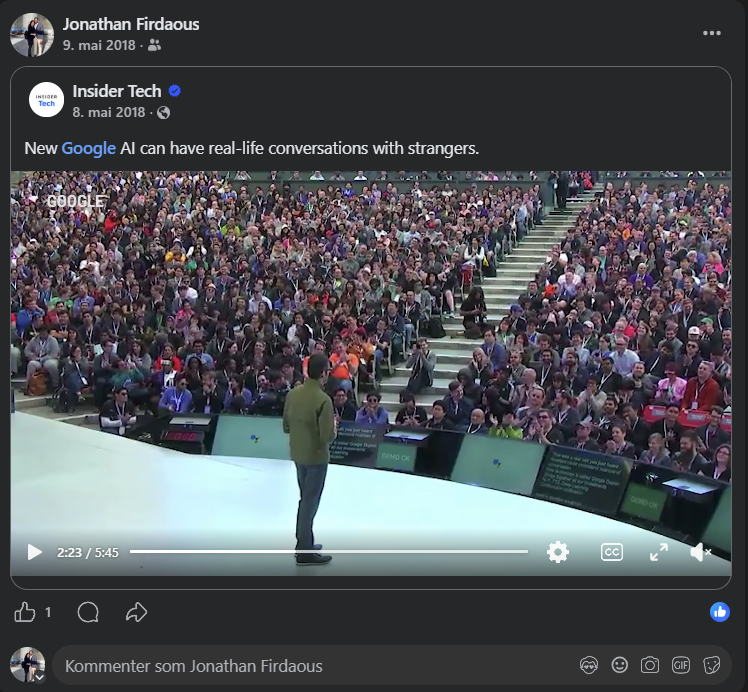
It took longer than I thought. But the direction was right.
What seemed far off back then is ready for real-world use today. The language models that have matured in recent years make it possible to build voice agents that actually work: tools a business can build its customer conversations, sales, booking and support around.
Within five years, more than 90% of all phone activity between customers and businesses will be handled by AI voice agents.
Ninety per cent sounds high until you follow the reasoning.
Businesses that adopt voice agents gain two competitive advantages at once. The first is about customers: a customer who calls wants an answer straight away. Nobody likes waiting in a queue, listening to hold music, being bounced between departments or waiting tens of minutes for help with a question that can often be solved in under a minute. A voice agent answers when the customer calls. It understands what the customer needs, asks the right follow-up questions, finds information, books meetings, follows up enquiries and resolves the matter there and then.
That is nothing like the phone experience most of us know today.
Think of the last time you called for help with something urgent. A maze of keypad menus. You sat in a queue. You were transferred. Maybe you were told to send an email. You hung up, irritated, and perhaps decided to shop somewhere else next time.
The second competitive advantage is about money: an AI voice agent can cut costs by 40–80% compared with handling calls manually. That saving goes straight to the bottom line. Businesses that adopt this get lower costs, higher capacity and better availability, all at once. That makes them more resilient. It gives them room to invest, expand and grow faster than their competitors.
The figures are based on our own calculations comparing the cost per call with manual agent set-ups. Gartner estimates that conversational AI will reduce global agent costs by $80 billion by 2026, and that wages account for up to 95% of operating costs in contact centres.
These two advantages build on each other: happier customers buy more. They come back. They recommend you. They speak well of the business. At the same time, everyone in sales and marketing knows that CAC is a major cost driver. Winning new customers is expensive. Keeping the ones you already have is far cheaper. When better availability brings higher customer satisfaction and lower costs at the same time, the effect goes well beyond efficiency. It becomes a structural advantage.
Advantages like these decide markets. Those who seize them first eat those who don't.
Think about what people actually call businesses about. Booking an appointment. Changing an appointment. Checking opening hours. Getting an update on a case. It is routine, and it makes up most of all phone traffic. The calls that need human assessment or judgement are the small part.
So the 90% figure follows directly from two competitive advantages now lying open on the table, and from the fact that only some will seize them in time.
The phone is here to stay, and it is becoming more important. When something is urgent, when something is unclear, when the customer wants to buy, book, change, clarify or get help, the phone is still the most direct channel between customer and business. The real challenge has always been capacity on the other end of the line.
That is what Agentia has solved.
Agentia builds AI voice agents for businesses that want to be available when their customers actually get in touch. Agents that speak your customers' language naturally, understand what the customer wants and connect to the systems the business already uses, so they can update information and carry out actions just as a person would, both during and after the call.
Technology is only part of the story. This is also about how businesses use their people.
Many tasks are going to change. It has happened before, and each time human effort has moved on to work of higher value.
The same is happening now. People who today have to interrupt patient care, customer meetings, production or skilled work to answer the phone get time back. Customer service staff who spend much of the day on repetitive questions can spend more time on the cases that really need assessment, reassurance and human judgement. Salespeople can spend more time on the right conversations. Receptions and front desks can stay available without everything grinding to a halt every time the phone rings.
The dividing line runs between conversations that need human judgement and conversations that don't. Agents can take the rest. That line is moving faster than most people think.
This is what we are building.
For Norwegian businesses, this means something concrete. A voice agent that is going to work in Norway has to understand Norwegian customers, the Norwegian language and its dialects, Norwegian ways of working and Norwegian privacy requirements. A standard international solution with Norwegian added on top is not enough. The agent has to represent the business in a way that actually works day to day.
The difference between an impressive demo and a solution that creates value every day lies in the details. How the agent asks questions. When it waits. When it escalates. How it speaks on behalf of the business.
Within five years, your customers will expect your competitors to answer with an AI voice agent. What will set the best apart from the rest is the quality of the agent, the integrations behind it and how well it represents you.
When I saw the restaurant demo eight years ago, I thought AI would take my job. I was wrong. It changed my job. That is why I am building Agentia, together with four other founders who have delivered production systems for years.
The difference between us is that you have an advantage I didn't have: the technology works in real-world use now. Those who act first eat those who don't.
Agentia is built for those who want to be first.
Founder, Agentia AS